Psychometric Assessment Return on Investment (ROI)
Save Time
Get the best fit candidate the first time around
Save Money
Avoid the costs associated with re-recruiting
No Dissapointment
Avoid poor performing staff or an ineffective manager
Schmidt & Hunter (1998) Research
There are three main points to consider:
The economic value of gains in improved hiring methods are typically quite large
These gains are directly proportional to the size of the increase in validity when moving from the old to the new selection methods
No other characteristic of a personnel measure is as important as predictive validity
The predictive validity coefficient of an assessment is directly proportional to the practical economic value of the assessment method (Schmidt & Hunter, 1998). This is because increased predictive validity leads to substantial increases in employee performance, including increased outputs, the increased monetary value of those outputs and increased learning of job-related skills (Schmidt & Hunter, 1998).
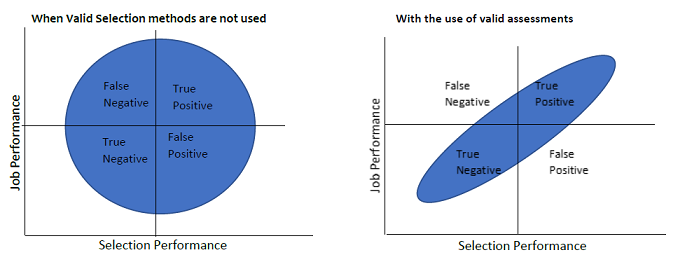
Reducing the odds: The use of psychometric assessments increases the validity and reduces the margin of error which is involved in any selection process. There will always be a proportion of false positives and false negatives but using valid psychometric assessment methods reduces the number of candidates falling into these categories.
What does this mean in practice?
To get the desired results, you need to be crystal-clear on what you want to measure, then allow a psychometrist to select a combination of the best assessments that are fit for purpose. It is essential that job profiles and competencies are clearly defined. If the job analysis and competency framework used as a basis for selecting appropriate tests is poorly compiled, then the assessment outcomes might not have as great an impact as what is desired.
How psychometrists use psychometric assessments for selection?
Undertake a thorough job analysis to identify the capabilities and competencies required of the job.
Select valid and reliable tests that are fit for purpose.
Provide appropriate feedback, which never involves a clinical diagnosis, but rather provides a selection recommendation.
The employer compliments assessment results with other sources of information about the candidate such as interview scores and experience.